How to Hang a Large Canvas Print Without Damaging Your Wall
A large canvas print gives a living room, bedroom or hallway an instant focal point. The trick is hanging it securely without wrecking fresh paint or losing your deposit on a rented home.
• Canvases up to about [7] kg: use large removable picture-hanging strips on a smooth, painted wall, and they're designed to come off cleanly.
• Heavier canvases, or wallpaper and textured walls: use one or two small picture hooks, which leave pin-sized holes that are easy to fill.
• Very heavy pieces: use screws with the right wall plugs for plasterboard or brick.
This guide explains how to hang a canvas print step by step: how to choose the right method for your canvas weight and wall type, how high to hang it, and how to take it down again cleanly.
Which hanging method suits your canvas?
|
Canvas size (2 cm frame) |
Approx. weight |
Best no-damage method |
Best method with fixings |
|
Up to 40x60 cm |
Under 1.5 kg |
2 pairs of medium picture-hanging strips |
1 picture hook |
|
60x90 cm |
2–3 kg |
4 pairs of large picture-hanging strips |
1–2 picture hooks |
|
75x100 cm |
3–4 kg |
4 pairs of large strips, if within the pack's rating |
2 picture hooks |
|
100x150 cm and larger |
5–8 kg+ |
Easel or picture rail |
2 screws with wall plugs |
|
Any size with a heavy frame |
Weigh it |
Easel or picture rail |
Screws with wall plugs |
What you'll need
• Tape measure and pencil
• Spirit level, or a level app on your phone
• Bathroom scales to weigh the canvas
• Isopropyl rubbing alcohol and a clean cloth, if you're using strips
• Removable picture-hanging strips, or picture hooks and pins
• Paper or masking tape to make a template
• A friend to hold the canvas
Step 1: Weigh and Check Your Canvas
The weight of your canvas decides which hanging method is safe. Stand on the bathroom scales holding the canvas, then subtract your own weight.
Next, turn it over and check the back:
• Hanging hardware: is there a sawtooth hook, D-rings or a hanging wire already fitted?
• Contact area: for strips, you need a flat, rigid strip of wooden frame at each corner. Never stick strips to the canvas fabric itself.
• Frame depth: deeper frames (3–4 cm) are heavier, but give strips a larger, sturdier contact surface.
• Condition: look for loose staples, raised corners or damage.
Step 2: Identify Your Wall Type
UK homes mostly have one of three wall types, and each needs a different approach. Knock on the wall: a hollow sound means plasterboard; a solid, dull sound means brick or block.
|
Wall type |
How to tell |
Best hanging method |
|
Plasterboard (stud wall) |
Hollow sound; common in newer homes and extensions |
Strips for light canvases; plasterboard picture hooks or hollow-wall plugs for heavier ones |
|
Plaster on brick or block |
Solid sound; common in older homes |
Strips for light canvases; masonry nails or screws with plugs for heavy ones |
|
Wallpaper, Artex or textured |
Visible texture or paper |
Avoid strips, as they can tear the paper; use small picture hooks or an easel |
Freshly painted wall? Wait at least 7 days before using adhesive strips, and longer if the paint tin says so. Uncured paint can peel off with the strip.
Renting? Check your tenancy agreement. Many landlords allow small picture-hook holes but not screws.
Step 3: Decide How High to Hang Your Canvas
Hang your canvas so its centre is about 145–150 cm (57–60") from the floor: roughly eye level for most adults. Galleries use the same rule.
• Above a sofa or sideboard: leave a 15–25 cm gap between the top of the furniture and the bottom of the canvas.
• Above a bed: leave 20–30 cm above the headboard. Use screws or hooks rather than strips over a bed, so nothing can fall on anyone.
• Width rule: choose a canvas about two-thirds the width of the furniture below it. For a 210 cm sofa, that's a canvas about 140 cm wide.
• Hallways and stairs: keep to eye level as you walk past, and follow the angle of the stairs for a group of canvases.
Step 4: Plan the Position With a Template
Cut a piece of paper or card to the size of your canvas, mark where the hanging hardware sits, and tape it to the wall. Live with it for a day, view it from where you usually sit, and adjust before you put up any strips or hooks. Use a spirit level to check the template is straight.
Step 5: Hang Your Canvas
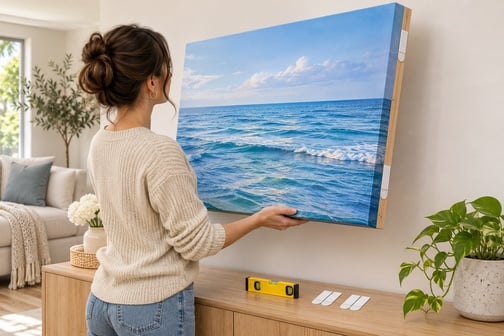
Option A – How to hang a canvas without nails (adhesive strips)
Removable picture-hanging strips are the best no-damage option for light to medium canvases on smooth, painted walls. Large strips typically hold up to about [7.2] kg per 4 pairs; check the weight limit printed on your pack.
1. Clean the wall and frame where the strips will go, using isopropyl rubbing alcohol. Household sprays leave a residue that weakens the bond.
2. Press the strip pairs together until they click, then stick one side to each corner of the wooden frame.
3. Peel off the wall liners and press the canvas onto the wall for 30 seconds, firmly at each strip.
4. Lift the canvas off the wall by its bottom corners, so the strip halves separate.
5. Press the strips left on the wall for another 30 seconds, then wait 1 hour before rehanging the canvas.
6. Rehang and level the canvas by pressing the strips back together.
Don't add extra strips to go over the weight limit; it doesn't raise the rating. And keep the pull tabs visible, because you'll need them to remove the strips.
Option B – Least-damaging way to hang with nails (picture hooks)
Picture hooks are the most secure method for most canvases. They leave only tiny holes that a dab of filler hides completely.
• Plaster on brick: use a brass picture hook with a hardened steel pin, driven in at an angle. A single hook typically holds 5–10 kg; check the pack.
• Plasterboard: use plasterboard picture hooks or self-drill hollow-wall plugs. Aim for the timber studs behind the board if you can find them.
• Wide canvases (over 75 cm): use two hooks about a third of the way in from each side, so the canvas stays level and doesn't tilt.
Option C – Hanging a heavy canvas (over 8 kg)
For heavy or oversized canvases, use screws with the right wall plugs:
• Brick: screws with masonry wall plugs
• Plasterboard: heavy-duty hollow-wall anchors or spring toggles, or screw into a stud
Hang the canvas on two D-rings rather than a single wire, so the weight is spread evenly. If you're not confident drilling, ask a handyman.
Option D – No fixings at all
• Picture rail: if your home has one, hang the canvas from rail hooks with cord or chain rated for its weight.
• Picture ledge or shelf: lean the canvas on an existing ledge with a lip to stop it slipping.
• Floor or easel: an oversized canvas leaned against a wall, or on a sturdy easel, looks relaxed and modern, and needs no holes at all.
Step 6: Check It's Level and Secure
Place a spirit level on top of the frame and adjust until it's straight. Gently press each corner: the canvas should sit flat without rocking. Don't tug on it to test the hold, as that can weaken adhesive strips.
Check strip-hung canvases every few weeks for lifting corners, especially in kitchens, bathrooms and rooms that get damp or very warm.
Step 7: How to Remove Adhesive Strips Without Peeling Paint
Removing strips correctly is what keeps your wall damage-free.
1. Lift the canvas straight up off the wall to separate the strip pairs.
2. Hold the base of the strip against the wall with one hand.
3. Pull the tab slowly, straight down, parallel to the wall, about 30 cm in total. Never pull it towards you.
4. If a tab snaps, use dental floss or fishing line to saw gently behind the strip, then roll off any residue with your thumb.
For picture-hook holes, fill with a little ready-mixed filler, let it dry, sand it lightly and touch up with paint.
How to Hang a Split or Multi-Panel Canvas
For a split canvas, leave 3–5 cm between panels for a balanced look. Hang the centre panel first, then use a spirit level and a spacer (a 4 cm offcut of card works well) to line up the panels on each side. Make a paper template of the full layout first. It makes getting the gaps right much easier.
Renter-Friendly Tips for Hanging Wall Art
• Use removable strips for canvases within the pack's weight limit, and keep the instructions for removal day.
• Choose lighter canvases with slim 2 cm frames to stay within strip limits.
• Ask your landlord whether small picture-hook holes are allowed. Many tenancy agreements permit them if you fill the holes when you leave.
• Lean an oversized canvas on a sideboard, shelf or the floor for a no-holes look.
• Photograph the wall before hanging, as a record for your deposit.
FAQs
What is the best way to hang a canvas without nails?
The best way to hang a canvas without nails is with large removable picture-hanging strips, fixed to the wooden frame at each corner. They suit canvases up to about [7] kg on smooth, painted walls. For heavier canvases or wallpaper, use a picture rail, a ledge or an easel instead.
How many hanging strips does a large canvas need?
Most large canvases need 4 pairs of large picture-hanging strips, one at each corner of the frame. Check the weight limit on your pack, and switch to picture hooks if your canvas is heavier.
How high should I hang a canvas?
Hang a canvas with its centre about 145–150 cm (57–60") from the floor. Above a sofa, leave a 15–25 cm gap between the furniture and the bottom of the canvas.
How do I hang a canvas on plasterboard?
Use adhesive strips for light canvases, plasterboard picture hooks for medium ones, and hollow-wall anchors or a timber stud for heavy canvases. Standard nails don't hold well in plasterboard.
How do I hang a heavy canvas?
Hang a heavy canvas (over about 8 kg) on two D-rings, using screws with masonry plugs in brick or heavy-duty hollow-wall anchors in plasterboard. Never use adhesive strips for heavy canvases.
Can I use ordinary double-sided tape to hang a canvas?
No. Ordinary double-sided tape isn't rated for hanging weight and can pull paint off when removed. Use removable picture-hanging strips made for wall art instead.
Can I hang a canvas on wallpaper?
Avoid adhesive strips on wallpaper, as they can tear it when removed. Use a small picture hook, which leaves a tiny hole, or display the canvas on a picture rail or ledge.
How do I hang a canvas in a rented home?
Use removable picture-hanging strips within their weight limit, or lean the canvas on a shelf or the floor. Check your tenancy agreement before using hooks or screws.
How long should I wait to hang a canvas after painting?
Wait at least 7 days after painting before using adhesive strips, so the paint can fully cure. Picture hooks can go up as soon as the paint is dry to the touch.
Conclusion
Ready to fill that empty wall? Choose from our large canvas prints or create your own personalised canvas print from any photo.